

Yes — service-area moving companies need dedicated local landing pages even when they have no storefront. Google still needs clear city and service signals to trust you for “movers near me,” multi-city queries, and the AI Overview that often sits above the map pack. A thin homepage and a generic service page are not enough when you roll trucks across several markets.
I’m Brad Leiphart, CEO of NetConnect Digital. NetConnect Digital has been in business since 2008, and today we help movers and other service businesses turn messy service areas into a landing-page system search engines — and answer engines — can understand. Below is how we build those pages for movers, what belongs on every URL, and how local pages feed both map visibility and Answer Engine Optimization (AEO).
Why movers lose visibility without local landing pages

Most movers are service-area businesses. You might be based in one warehouse but quote jobs in eight suburbs and three neighboring cities. Customers search by city, neighborhood, and job type — “piano movers in Arlington,” “apartment movers Dallas,” “long distance movers from Austin to Houston.” If those intents all land on the same homepage, Google has to guess which market you actually serve.
The map pack still matters for high-intent local searches. But more moving research now starts with questions and comparisons, and Google’s AI Overviews increasingly answer those before the pack. Comscore reported AI Overviews on about 39% of U.S. desktop searches by June 2026 (Search Engine Land / Comscore). Ahrefs’ large-scale analysis also found AI Overviews appear far more often on longer, question-style queries than on short local lookups (Search Engine Journal / Ahrefs). That is exactly how people research movers.
Local landing pages give you a durable URL for each real market: one place for citations, Google Business Profile alignment, reviews mentioning that city, and FAQ answers that match how customers ask follow-ups. That is digital marketing for moving companies done as a system, not a one-off blog post.
What a mover local landing page actually is
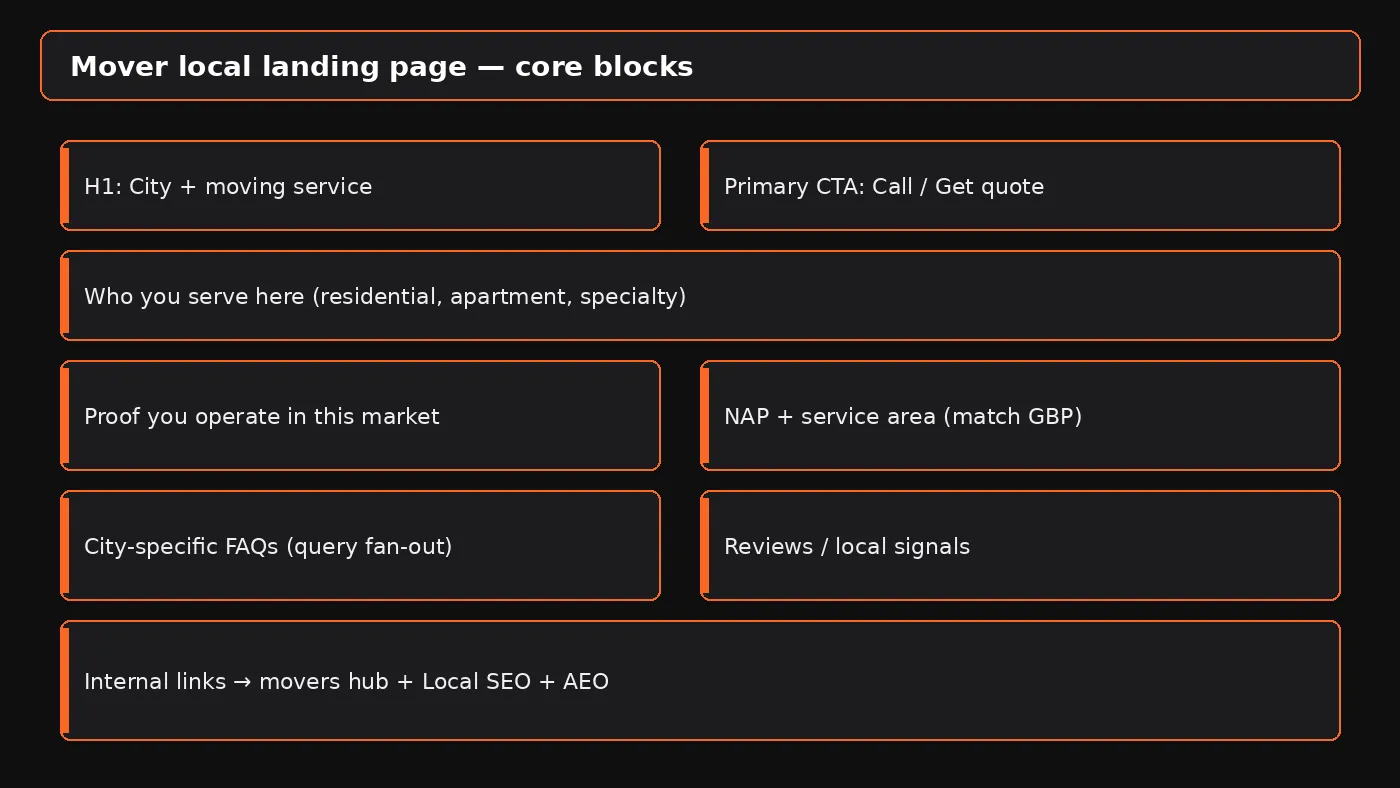
A local landing page is not a spun city paragraph bolted onto a template. It is a focused page that proves you serve a specific area with a specific set of services. Think of it as one of the four local pillars we score with clients — alongside data accuracy, citations, and reputation — not as a content farm.
Each strong page usually covers:
- A clear H1 that names the city (or metro) and the moving service
- Who you serve there (residential, apartment, commercial, senior, military, piano, packing)
- Proof you operate in that market: cities and neighborhoods you actually roll into, licensing notes where relevant, and language customers in that market use
- NAP consistency with your master business data (name, address, phone, service area)
- Embedded or linked Google Business Profile signals when the profile covers that area
- FAQs pulled from real sales and dispatch questions in that market
- A single primary CTA — call or quote — without burying the phone number
If you want the broader SEO foundation first, start with our SEO checklist for moving companies, then come back here for the landing-page build.
How many local pages should you publish first?

Publish pages for markets you can defend — not every ZIP code on a map. A practical first wave for a multi-market mover is:
- Your HQ / warehouse city
- The next two to five cities that already produce booked jobs
- One page per high-intent specialty that you sell market-wide only if the specialty is real (for example piano or commercial), not dozens of near-duplicate specialty×city combos on day one
Expansion comes after those pages earn reviews, citations, and internal links. Thin pages for cities you rarely serve waste crawl budget and weaken trust. We would rather see ten solid pages than fifty empty ones.
NAP and service-area signals every page should carry

Answer engines and local algorithms lean on consistent facts. Before we write copy, we build a master business data sheet — semantic facts such as “[Company] offers residential moving in [City]” — and keep a “quoted Google” check column so citation errors get caught early.
On every landing page, make sure these signals agree with that sheet:
- Name, address, phone exactly as they appear on your Google Business Profile and major citations
- Primary phone clickable on mobile; for movers that is often (800) or a local tracking number that still resolves to the business
- Service area described in plain language (cities and counties you serve), not a keyword dump
- Hours, licensing, and insurance when customers expect them in that market
- Same entity language across the page, footer, and schema so AI systems do not invent a second “version” of your company
Inconsistent NAP is still one of the fastest ways to stall local SEO for moving companies. Fix the data sheet first; then scale pages.
How local pages help you show up in AI Overviews above the map pack

Service-area movers should plan for two SERP surfaces: the map pack and the AI Overview that can sit above it on research queries. Local pages help the overview layer when they:
- Answer the question in the first paragraph (AEO-friendly structure)
- Use FAQ sections built from query fan-out — the 20–30 follow-ups customers ask after “movers in [city]”
- State verifiable facts (services, areas, process) instead of vague marketing claims
- Earn supporting signals from reviews, citations, and authoritative local mentions that models already trust
This is AEO — Answer Engine Optimization — layered on top of classic local SEO. It is not a replacement for Google Business Profile work, reviews, or citations. It is how those assets get cited when someone asks ChatGPT, Google’s AI Overview, or another assistant which movers serve their city.
A practical build order for your first landing-page set
- Audit demand — pull 12–16 months of Search Console and call/quote data by city
- Map competitors — note which cities they own and which FAQ themes they cover
- Close GBP gaps — categories, services, and photos aligned to the markets you will publish
- Lock the data sheet — one source of truth for NAP and service areas
- Outline, then write — unique proof per city; interview ops/sales for local language
- Internal link from your movers hub and related service pages
- Measure for 3–6 months — impressions, calls, quote starts, and assisted conversions by URL
That workflow is the same one we use across our moving company marketing engagements. Direct mover SEO and PPC with NetConnect Digital run for an initial 6 months, then month-to-month — long enough for organic work to compound without locking you into a forever contract.
How this differs from a generic SEO checklist
A checklist tells you what to tighten sitewide: titles, speed, GBP, reviews, on-page basics. This landing-page system is the execution layer for multi-market visibility. Checklists keep the house in order. Local pages are how a service-area mover shows up in Arlington on Tuesday and Plano on Thursday without confusing Google about who you are.
If you already have the checklist done, the next growth lever is almost always the city and service-area page set — written for humans first, structured so answer engines can quote you.
FAQ: local landing pages for movers

Do service-area movers need city landing pages if they have no storefront?
Yes. Storefront or not, Google and AI systems need city-level proof of where you operate. Pages that name real markets, services, and contact details outperform a single generic homepage for multi-city movers.
How many local pages should a multi-market mover publish first?
Start with your HQ city plus the next two to five cities that already produce booked jobs. Add more only when you can support them with real service history, reviews, and unique content.
What NAP and service-area signals should appear on every mover landing page?
Consistent name, address, and phone; a clear service-area description; clickable phone CTAs; and the same entity facts you use on your Google Business Profile and citations.
How do local pages help a mover show up in AI Overviews above the map pack?
They create cite-able answers — clear facts, city-specific FAQs, and consistent business data — that answer engines can use on research queries that often appear above local map results.
How is this different from a generic SEO checklist for moving companies?
A checklist covers sitewide hygiene. Local landing pages are the market-by-market system that turns service areas into rankable, quotable URLs for both classic local SEO and AEO.
Ready to build pages that match how customers search?

If your movers site still funnels every city into one thin page, you are leaving map-pack and AI Overview visibility on the table. NetConnect Digital has delivered 3,500+ projects since 2008, and we build mover local SEO the same way we run the work ourselves: clear data, real markets, measurable pages.
Call (800) 784-8815 for a free mover SEO audit, or request a free consultation. Direct mover SEO engagements are 6 months, then month-to-month.