Google’s May 2026 AI Overviews Update: 7 Fixes to Make Now


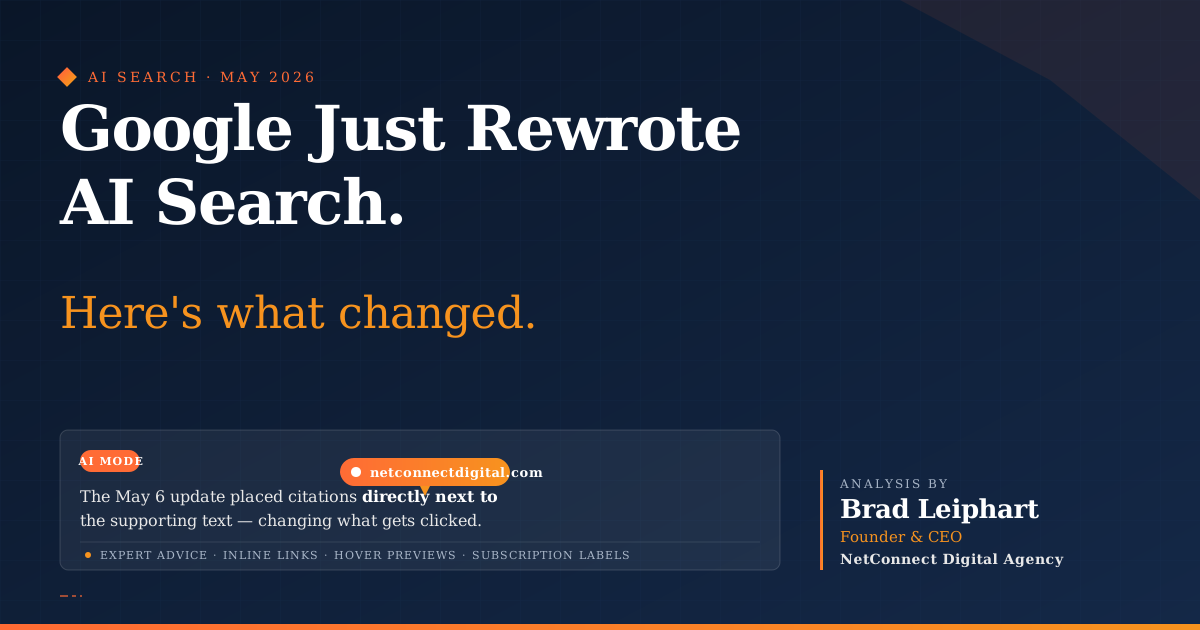
- On May 6, 2026, Google rolled out five structural changes to AI Overviews and AI Mode — the biggest update since AI Overviews launched.
- Inline citations now sit next to the specific text they support, hover previews show site names on desktop, and a new “Expert Advice” block pulls first-hand perspectives from forums, social media, and review sites.
- AI Overviews now appear in roughly 25.8% of all U.S. searches and about 50% of informational queries. Organic CTR on AI-Overview pages has dropped as much as 61%.
- The winners under this update are not the sites that “rank #1.” They are the sites that get selected, quoted, and cited inside the AI response — and that requires a different kind of content.
- Below is a 7-point checklist any business can run this week to start earning AI citations instead of losing clicks.
What Actually Changed on May 6
Google’s VP of Product Management for Search, Hema Budaraju, announced five updates to AI Mode and AI Overviews. Here is what each one does and why each one matters:
1. Inline Source Links
Citations used to live in a pill stack at the bottom of an AI answer. Now they appear directly next to the specific sentence or bullet point the AI is drawing from. If an AI Overview lists three considerations for choosing a moving company, each consideration can carry its own outbound link to a different source.
Why it matters: Granular attribution rewards focused, single-purpose content. A page that answers one question crisply now has a real chance of being cited even if a thinner, broader competitor outranks it traditionally.
2. Hover Previews on Desktop
Hovering over an inline link now surfaces a preview card with the site name and page title before the user clicks. Google explicitly stated that searchers hesitate to click when they cannot tell where a link will take them.
Why it matters: Brand recognition just became a CTR factor inside AI search. A user who recognizes your brand from the hover preview is materially more likely to click. Sites with weak, generic, or inconsistent branding are about to leak clicks even when cited.
3. Subscription Labels
When an AI answer cites a publication the user pays for, a “Subscribed” tag now appears next to the link. Google’s early testing reports that users were significantly more likely to click links labeled this way.
Why it matters: This is a publisher-specific feature today, but the principle generalizes — trust signals attached to citations move clicks. Expect Google to expand this signal to other forms of trust (verified business, expert author, schema-validated organization) over time.
4. The “Expert Advice” Block
AI responses now include a dedicated section pulling first-hand perspectives from public discussions — Reddit, forums, review sites, social posts — with the creator’s name, handle, or community attached.
Why it matters: This is the most overlooked change in the whole update. Google is openly signaling that first-hand experience content gets its own real estate inside the AI response. SEO researcher Lily Ray called this the moment first-hand experience stopped being just an E-E-A-T component and started being a direct click driver. Generic, ghost-written, fact-aggregator content is the loser here.
5. “Explore New Angles” Suggestions
At the end of many AI responses, Google now surfaces a section of follow-up topic links — usually deeper subtopic articles, case studies, or comparisons. This converts the AI answer from a dead end into the start of a research session.
Why it matters: Subtopic depth is back. The brand with one strong pillar page loses to the brand with a connected hub of subtopic pages — because the latter can populate multiple slots in “Explore New Angles.”
Why This Is Bigger Than the Headlines
It is easy to read this as a cosmetic UX tweak. It is not.
Referral traffic from search has dropped 22% for large publishers, 47% for medium publishers, and 60% for small publishers over the last two years. AI Overviews currently appear on roughly a quarter of all U.S. searches and on about half of informational queries. Penske Media has alleged that AI Overviews suppress clicks by as much as 90% on some queries.
In other words: traffic is not coming back the way it used to. What Google is doing — quietly, deliberately — is rebuilding the click economy around a different signal. The old signal was rank. The new signal is citation worthiness: can the AI extract your content cleanly, attribute it confidently, and present it as a trustworthy source the user wants to click?
That is not the same problem as “rank #1 for the keyword.” It is a new optimization layer. Most marketers are calling it Generative Engine Optimization (GEO) or, when paired with structured answers, Answer Engine Optimization (AEO).
The May 6 update did not invent GEO. It made GEO measurable.
What Gets Selected by AI Now
After watching this play out across our client portfolio — and across the AI-search literature published in the last 60 days — a pattern is unmistakable. Content that gets cited tends to share these characteristics:
- Clean answer paragraphs. Two to four sentences that define a concept or answer a question in plain language without preamble. AI models extract these reliably.
- Specificity over hedging. Numbers, timeframes, prices, constraints, named methods. AI prefers content it can quote with confidence.
- Named, credentialed authorship. Real bio, real expertise, real photo. This is the E-E-A-T signal that now powers the Expert Advice block.
- First-person experience. Phrases like “in our experience,” “after auditing X client sites,” and “what we observed” are no longer just stylistic — they are extractable signals.
- Structured headings that match real questions. H2s phrased as the questions a user would actually type or speak.
- Strong factual framing. Definitions, comparisons, step-by-step procedures, decision frameworks. These are the building blocks AI uses to assemble an answer.
- Validated structured data. Organization schema, Person schema for the author, FAQ schema where genuinely useful, Article schema with clear publication and modification dates.
The brands winning citations are not publishing more. They are publishing clearer.
The 7-Point Checklist: Fixes to Run This Week
These are the seven adjustments I would prioritize on any commercial site this week — in roughly the order they pay off.
1. Rewrite Your Highest-Intent Pages for Extractable Answers
Pick your top 10 commercial pages. Open each one and find the first 100 words. Ask one question: does a 2 to 4 sentence answer to the page’s core question appear above the fold, in plain prose, without fluff?
If not, write one. Place it directly under the H1. Do not bury it.
2. Add a Real Author Box With Schema
Every commercial page should have a named author with a bio, photo, credentials, and Person schema in the JSON-LD. Anonymous, byline-less content is the easiest type of content for an AI model to pass over in favor of a competitor with attribution.
3. Convert the FAQ at the Bottom Into Structured Q&A With Schema
Most service-business sites have an FAQ section. Most of those FAQ sections are not marked up with FAQPage schema, are not phrased as natural questions, and answer each question in a single dense paragraph. Fix all three. Phrase the question the way a real searcher would speak it. Answer in two to four short sentences. Wrap the whole block in valid FAQPage JSON-LD. This is the fastest AEO win available right now.
4. Inject First-Hand Experience Into Your Service Pages
Add a paragraph to each major service page that says, in plain English, what you have actually observed doing this work. Phrases like “across the 20+ moving company clients we manage” or “after auditing X med-spa websites this year” are now ranking signals, not just stylistic flourishes. The Expert Advice block is reading for them.
5. Build Subtopic Hubs Around Every Pillar Page
Look at your money pillar pages — the ones that drive leads. Each one should be supported by 4 to 8 subtopic pages answering specific, narrower questions a user would ask in follow-up. This is what “Explore New Angles” is going to pull from. A single pillar page in isolation has one shot at being cited. A pillar surrounded by 6 well-structured subtopics has seven.
6. Tighten Your Brand’s Visual Identity in Search
Because hover previews now surface your site name and page title before the click, your brand needs to be recognizable in two seconds. Audit your title tags, your favicon, your site name consistency across structured data, and your meta descriptions. If your brand looks generic in a hover card, it will lose clicks to a competitor that does not.
7. Segment AI Search Referrals in Analytics
Most teams have no idea how much of their declining organic traffic is AI-cited versus AI-suppressed. Create a referrer segment for AI Overviews, AI Mode, ChatGPT, Perplexity, and Copilot. Track landing pages, query patterns, and assisted conversions separately. You cannot optimize what you cannot see, and direct clicks alone no longer tell the story.

What This Means for Local and Service Businesses
If you run a service business — a moving company, a med spa, a contractor, a regional retailer — there is good news in this update. The Expert Advice signal, the first-hand experience signal, and the subscription-style trust signal all favor businesses that actually do the work over content farms that aggregate it.
A moving company that has run 5,000 jobs in a single market has something an AI engine cannot synthesize from public data: specific, hyperlocal, first-hand operational knowledge. A med spa with a board-certified medical director has authority signals a content farm cannot fake. The May 6 update rewards exactly that kind of authentic, named, experienced content — provided it is structured in a way the AI can extract.
That is the meta point. AI search did not kill local and service business SEO. It made authenticity, expertise, and structure the new ranking factors.
What to Do Next
If your site has not been audited for AEO and structured data since this update rolled out, that audit is the highest-leverage marketing work you can do in the next 30 days. We run AEO audits for service businesses across the country — schema deployment, first-hand-experience content rewrites, subtopic hub buildouts, and AI-referral analytics setup all included. If you want to see where your site stands, reach out at netconnectdigital.com.
The brands that adapt to AI search early are going to be the hardest ones to displace later. The window for being early is now.
Frequently Asked Questions
What changed in Google AI Overviews on May 6, 2026?
Google rolled out five updates to AI Overviews and AI Mode: inline source links placed next to the specific text they support, hover previews showing site name and page title on desktop, “Subscribed” labels on links from paid publications, a new “Expert Advice” block pulling first-hand perspectives from forums and social media, and an “Explore New Angles” section suggesting subtopic links at the end of AI responses.
How often do AI Overviews appear in Google search results in 2026?
AI Overviews now appear in approximately 25.8% of all U.S. searches and roughly 50% of informational queries. Organic click-through rate on pages that trigger an AI Overview has dropped by as much as 61% compared to traditional search results.
What is the difference between SEO and AEO in 2026?
SEO (Search Engine Optimization) focuses on ranking a page in the traditional 10 blue links. AEO (Answer Engine Optimization) focuses on getting a page selected, quoted, and cited inside the AI-generated answer itself. AEO emphasizes clean answer paragraphs, structured data, named authorship, first-hand experience signals, and subtopic depth. Both matter in 2026, but AEO is where new traffic growth is happening.
How do I get my content cited in Google AI Overviews?
Focus on extractable content: a 2 to 4 sentence answer to the page’s core question placed above the fold, a named author with bio and Person schema, FAQ sections marked up with FAQPage schema, first-person language describing real experience, structured H2s phrased as user questions, and subtopic hubs supporting each pillar page. Validate your structured data and segment AI search referrals separately in analytics.
Does the May 6 Google update affect local businesses?
Yes, and generally in a positive direction for businesses that actually deliver services locally. The new “Expert Advice” block and first-hand experience signals reward businesses with genuine operational knowledge and named expert authorship. Local service businesses that document their real experience with structured, well-marked-up content are positioned to earn more AI citations under this update, not fewer.
What is the Expert Advice block in AI Overviews?
The Expert Advice block is a dedicated section in AI Overviews and AI Mode responses that pulls first-hand perspectives from public discussions — forums, review sites, social media, and similar sources — with the creator’s name, handle, or community attached. It surfaces alongside the main AI summary and is specifically designed to bring authentic, experience-based content into the answer.
Brad Leiphart is the founder and CEO of NetConnect Digital Agency, a Savannah-based digital marketing firm specializing in WordPress development, Google Ads, and AEO/SEO for service businesses. NetConnect has deployed structured data and AEO strategies across more than 20 client sites in the moving, healthcare, and energy verticals.